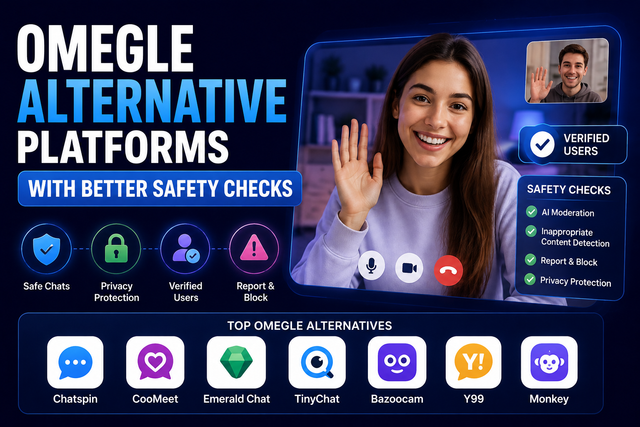
Every random chat platform claims to be safe. It's practically boilerplate at this point — a line in the footer, a badge somewhere on the homepage, a vague mention in the terms of service. What's rarely explained is how any of that safety actually gets enforced in real time.
That distinction matters more than people realize. A platform can say all the right things and still have almost nothing in place to back it up. So let's actually look at what a functioning safety check looks like, and why some platforms are built more carefully than others.
The Problem With "Trust Us" Safety Claims
A lot of platforms treat safety as a policy issue rather than a technical one. They'll have community guidelines, a terms-of-service page, maybe a report button — and consider that sufficient.
The issue is that none of those things actually stop something from happening in the moment. Guidelines don't detect nudity. A terms page doesn't verify age. They're reactive at best, and often not even that.
Real safety checks need to happen actively, during the chat itself, not as a policy document nobody reads before clicking "agree."
What Actual Detection Looks Like
The platforms doing this well have moved toward automated detection systems that work while a conversation is happening, not after the fact. There are a few core pieces worth understanding.
In-Browser Detection
This type of check runs directly on the user's device, scanning video in real time as the chat happens. It's fast, because there's no round trip to a server involved — it can flag something almost instantly.
The downside is that in-browser checks alone can be limited by the device itself, and in some cases can be bypassed by users who know what they're doing.
Server-Side Detection
This is a second layer that processes video on the platform's own servers, independent of whatever's happening on the user's device. It's harder to get around, because it doesn't rely on anything the user's browser is doing locally.
The tradeoff is usually speed — server-side checks can take slightly longer to flag something compared to local detection.
Why Running Both Matters
Using only one of these methods leaves a gap. In-browser alone is fast but exploitable. Server-side alone is more reliable but can lag. Running both together closes most of that gap, since each one covers where the other might fall short.
This is exactly why Spoqi runs its nudity and age detection both in-browser and on the server, rather than picking one method and calling it sufficient.
Age Verification Deserves the Same Scrutiny
Nudity detection tends to get most of the attention in these conversations, but age verification is arguably just as important, especially for platforms meant strictly for adults.
A checkbox that says "I confirm I am 18 or older" isn't verification — it's an honesty policy. Anyone can click it regardless of their actual age.
Automated age detection running alongside the same dual-layer system changes that dynamic. It's not foolproof, no system is, but it's a meaningfully more active approach than relying entirely on self-reporting. Spoqi's 18+ enforcement works this way, using the same detection infrastructure rather than a separate, weaker checkbox system.
Reporting: The Part Most Platforms Get Wrong
Detection systems catch a lot, but not everything, which is why reporting tools still matter as a backup layer. The problem is that most platforms design this feature poorly.
Here's the common failure point: reporting only works while the chat is still active. The moment the other person disconnects, or you leave, the option disappears. Given how quickly a bad interaction can unfold, that's a serious gap.
Spoqi addresses this directly by keeping reporting functional even after a chat has ended. That means a user who's caught off guard in the moment still has a real path to flag it once they've had a second to process what happened.
Where Data Retention Fits Into Safety
Recording policies don't usually get filed under "safety," but they should. If a platform is storing video sessions, that's a whole additional risk surface — data breaches, misuse, unauthorized access.
Spoqi keeps no recordings of any chat. That's a deliberate design choice that removes a category of risk many platforms haven't fully addressed, particularly ones that were built before privacy expectations shifted as much as they have in the past few years.
How to Actually Evaluate a Platform's Safety Claims
Given all of this, here's a more useful checklist than just reading a homepage's "Safety" section:
- Does detection happen in more than one place, or just relying on a single method?
- Can you report something after a chat has already ended, or only while it's live?
- Is age verification active, or just a self-reported checkbox?
- Does the platform clearly state whether sessions are recorded?
- Is any of this explained in plain language, or buried in a terms-of-service document?
If a platform can't answer most of these clearly, that's worth noting before you commit any real time to it.
Comparing How Different Platforms Approach This
Since the shutdown of the original Omegle, the alternatives that emerged have taken noticeably different approaches to safety infrastructure, and it's worth understanding those differences before choosing one.
Looking at Omegle-Style Platforms
The original platform struggled specifically because its moderation approach couldn't scale with its user base. If you're researching a modern Omegle Alternative, it's worth specifically checking whether the platform's detection systems were built for scale from the start, rather than added on as user numbers grew.
Looking at OmeTV-Style Platforms
OmeTV's filtering tools give users some control over matches, but filtering and active safety detection aren't the same thing. When comparing an Ometv Alternative, it's worth separating those two features out rather than assuming one implies the other.
Looking at Emerald Chat-Style Platforms
Emerald Chat's interest-based matching is a genuinely useful feature for conversation quality, but it doesn't replace the need for content detection. If you're evaluating an Emerald Chat Alternative, check what's actually happening behind the matching system, not just how the matching itself works.
Why This Level of Detail Actually Matters
It might seem excessive to dig this deep into how a chat app handles safety, but this is exactly the kind of platform where it matters most. Unfiltered, anonymous, one-on-one video chat with strangers carries real risk if the underlying systems aren't built carefully.
The apps worth using in 2026 are the ones that treat safety as active infrastructure, not passive policy. That distinction is the difference between a platform that protects you and one that just says it does.
Final Thought
Vague safety claims are easy to make and hard to verify. What actually matters is whether detection is layered, whether reporting stays functional after the fact, and whether your data is being handled responsibly in the background.
If you want to see this kind of dual-layer safety system in action, it's worth trying Spoqi and getting a feel for how it actually works during a live conversation.
Comments