Laos eVisa Requirements for Spanish Passport Holders
If you are a Spanish national planning a trip to the Land of One Million Elephants, traveling to Laos has become much easier thanks to the introduction of the digital visa system. European travelers can now complete the entire process online without visiting an embassy. This comprehensive guide explains the required documents, entry procedures, and key travel details for a smooth journey from the streets of Madrid or Barcelona to the serene banks of the Mekong River, with a special focus on Laos eVisa for Spanish Nationals.
What are the Laos eVisa requirements?
It is important to ensure you collect the right paper work before starting the digital application to save time. Spanish travellers are to make the following:
A Valid Spanish Passport: Your passport must be valid for at least six months from the date you intend to enter Laos. Crucially, check for at least one blank page for the physical entry stamp.
Digital Passport Photo: You need a recent, professional passport-sized photo. It must have a plain white background and be uploaded in JPEG or PNG format.
Travel Itinerary & Lodging: You must provide details regarding your intended entry point and proof of accommodation, such as a hotel reservation in Luang Prabang or Vientiane.
Bio-Data Page Scan: A high-resolution color scan of your passport's information page is mandatory. Ensure no parts of the text are cut off or blurred.
How to apply for an eVisa for Laos?
The process is designed and can be completed entirely from your home or office. When you Apply for Laos eVisa, everything is handled online.
Form Completion: your personal details exactly as they appear on your Spanish passport.
Document Upload: Attach your digital photo and the scan of your bio-data page.
Review Phase: Double-check every letter of your name and passport number. Even a small typo can lead to entry issues at the border.
Submission: After paying the fee, you will receive a reference code to track your application.
How long does it take for a Spanish visa to be processed?
The digital system is not instantaneous as well as fast. As a rule, Spanish nationals are likely to receive their processing in 3-5 business days. Nevertheless, it should be very well advised to apply at least 7 to 10 days prior to flying to Laos in order to take into consideration the public holidays there or any possible demanding of further information.
How much is the fee to apply for a visa?
The price of an eVisa to Laos is not stable; it varies depending on a number of factors.
Variable Factors: The fee depends on your nationality (Spain), the current processing speed selected, and any administrative service charges.
Fee Checker: It is best to use the interactive fee tool on the visa portal to get the most accurate, real-time price.
Payment Security: Payments are handled via a secure online gateway. Spanish cards (Visa, Mastercard, etc.) are widely accepted.
What payment methods does visa accept?
In the case of applicants in the Spanish language, the system favors modern digital payment standards. You can use
Major Credit Cards (Visa, Mastercard, American Express).
Debit Cards enabled for international online transactions.
Ensure your bank is aware of the international transaction to prevent an automatic fraud block during the checkout process.
What are some travel tips for Laos?
In order to make sure that your Spanish-to-Laos travelling plans succeed without any hitches, you should do the following professional things:
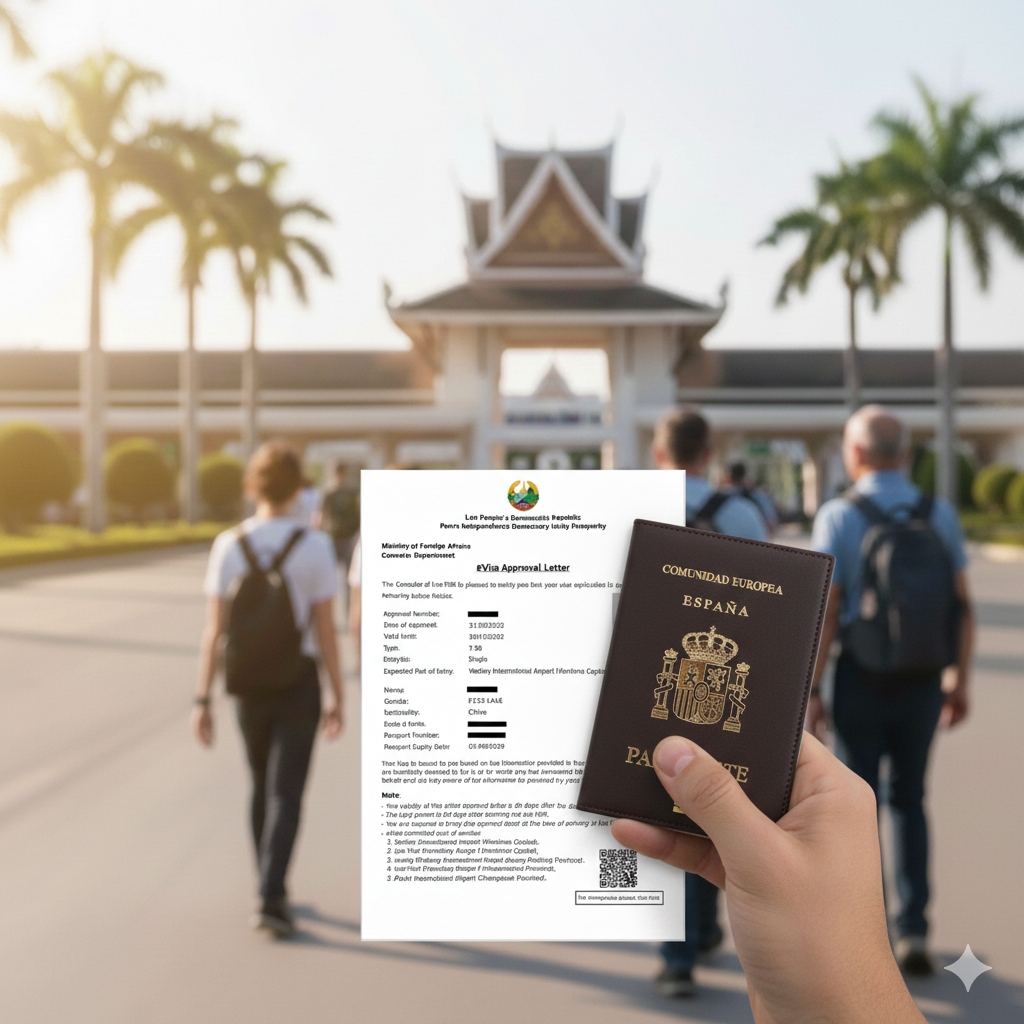
Print Everything: While it is an "electronic" visa, Lao border officials require a physical printout of your Approval Letter.
Accuracy is Key: Ensure the "Entry Point" you select on the form matches where you actually arrive.
Email Access: Use an active email address that you check regularly, as the approval will be sent there.
How Long Does Laos eVisa Stay in Pending Status?
In the event that you are a citizen of Spain and your application status has not been updated in several days, you need to take the following steps:
Verification: Re-log into the portal and check if there is a message requesting a clearer photo or a corrected passport number.
Patience: If it has been less than 5 working days, the application is likely still in the standard queue.
Support Contact: If the delay exceeds 7 days, use your reference number to contact the support team via the portal's contact form.
Can I get a Laos visa on arrival by land?
Yes, Visa on Arrival (VoA) is still present in several larger borders. Nevertheless, the eVisa is frequently chosen by Spanish travelingers due to the following reasons:
It eliminates long queues at the airport after a long-haul flight from Europe.
It provides peace of mind that your entry is pre-approved.
Note that not all land borders support eVisas, so check your route beforehand.
How long is a Laos E-visa valid for?
It is important to know the time frame of your visa to plan your itinerary in Spain. Two different periods define the validity and duration of stay:
The Entry Window (Validity): The eVisa is typically valid for 60 days from the date your Approval Letter is issued. You must pass through a Lao border control point within this 2-month timeframe. If you do not enter within 60 days, the visa expires and you must apply for a new one.
Maximum Stay Duration: Once you arrive and receive your entry stamp, the visa grants a stay of up to 30 consecutive days.
Single-Entry Restriction: The eVisa is strictly for a single entry. If you leave Laos to visit a neighboring country like Thailand or Vietnam, your visa becomes void, and you cannot use it to re-enter.
Extension Potential: While the eVisa cannot be extended online, Spanish tourists can apply for a stay extension in person at the Immigration Department in Vientiane or other major provincial immigration offices. Extensions are typically granted for 30 days at a time for a small daily fee.
What is the most common reason for visa refusal?
To avoid a "denied" status, Spanish applicants should be wary of these common pitfalls:
Blurry Scans: If the passport bio-data page is unreadable, the application will be rejected.
Mismatched Data: If your middle name is on your passport but not on the visa form.
Incorrect Photo: Using a selfie or a photo with a dark background.
Validity Issues: Applying with a passport that expires in less than 6 months.
What are the entry requirements for Laos?
Entry is restricted to specific international checkpoints for eVisa holders. Currently, these include:
Vientiane International Airport (VTE) (Wattay).
Luang Prabang International Airport.
Pakse International Airport.
The Thai-Lao Friendship Bridges (I and II). If you plan to enter via a remote jungle land border, you may need a traditional paper visa from the embassy.
Are Healthcare Facilities in Laos Good for Tourists?
While Laos is a beautiful destination, its healthcare infrastructure is developing.
Major Cities: Vientiane has the most modern clinics (e.g., Alliance International Medical Centre).
Remote Areas: Medical facilities are basic.
Insurance: It is mandatory for Spanish tourists to have comprehensive travel insurance that includes medical evacuation to Thailand or Spain in case of emergencies.
What is the most popular food in Laos?
Your trip isn’t complete without sampling the local flavors. Lao food is vibrant, spicy, and made with fresh local ingredients that reflect the country’s traditions and daily life. Exploring Laos food culture allows travelers to enjoy unique dishes, street food experiences, and regional specialties that are deeply rooted in Lao history and hospitality.
Laap (Larb): The national dish:A minced meat salad with lime, chili, and mint.
Sticky Rice (Khao Niew): Served in a woven basket; it’s the staple of every meal.
Tam Muk Hung: Spicy green papaya salad (usually spicier than the Thai version).
Khao Piak Sen: A comforting wet rice noodle soup often eaten for breakfast.
Or Lam: A spicy, woody Luang Prabang stew made with vegetables and buffalo skin.
Sai Oua: Savory Lao sausage infused with lemongrass and kaffir lime.
Mok Pa: Steamed fish in banana leaves with plenty of herbs.
Khao Poon: Spicy rice vermicelli soup with a coconut milk base.
Naem Khao: Crispy rice salad with chunks of fermented sausage.
Lao Coffee: Grown on the Bolaven Plateau, it’s thick, strong, and delicious.
Conclusion:
The process of moving between Spain and Laos has never been made easier by the eVisa. You can get your travel authorization within a few days by making sure that your passport remains valid, your pictures are in focus and that your itinerary is in place. And just remember to, print your approval letter, observe the local traditions and relax in the amazing hospitality of the Lao people, but the first step to the wonderful trip starts with a successful digital application. Safe travels!
You need to more information related to Laos eVisa:


Comments